Σάββατο 31 Μαρτίου 2012

Making a telescope from the Web kamery.flv

Making a telescope from the Web kamery  | Делаем телескоп из веб-камеры 

Borrowed

The first edition of How to Make a Telescope was universally acclaimed as the best book ever written for making a Newtonian telescope. This 2nd Edition is almost three times larger and adds to the original text new chapters on making a Cassegrainian telescope, optical windows, and equatorial mounts. Chapters on eyepieces and astronomical seeing have been expanded. Computer programs written in generic BASIC for reduction of Foucault test data. Included are indexes for the three principle magazines that carry telescope making information: Sky and Telescope's "Gleanings for ATM's" from November 1941 through June 1998, Scientific American magazine from 1925 through 1959 and the complete run of  Telescope Making magazine.  This book is the most complete single work available on making reflecting telescopes. Here is how two leading astronomy magazines reviewed the 2nd Edition:
". . . Borrowed from my high school library more than 20 years ago, the earlier book (the First Edition) was my introduction to an avocation that has occupied many evenings and weekends since. That fondly remembered volume forms the core of this new one, with many additions to complement and expand the older text. Reading the text in preparation for this review was like rediscovering an old friend. Key to the book's quality is Texereau's writing style, his workshop hints, diagrams and where appropriate, expansions into theory. The accent is upon the practical --- details of just what it takes to fabricate an optical telescope . . ." "In the sections devoted to optics both novice and experienced "glass-pushers" will receive guidance that is as clear and in-depth as any that can be found in print . . ." "From the earlier edition he has retained complete instructions on the fabrication of a Newtonian telescope, including optics and mounting, and provides a well-written rationale for its choice as the novice's first telescope. For the new edition he has added detailed plans for the construction of a Cassegrain telescope, including both the primary and secondary optics. He even devotes a section—definitely not novice stuff — to fabrication of an optical window . . ." "I heartily recommend this new edition of How to Make a Telescope, both to the recently interested telescope maker and the seasoned "telescope nut." Novices will find the spicy, well-illustrated and detailed book that inspired me many years ago, while even old hands should find some new wrinkles within its greatly enlarged text..
                                      --Sky & Telescope magazine

Browsing through a library one day, my hands fell on a remarkable book. It was the thin first edition of Jean Texereau's How to Make a Telescope . . . here was Texereau describing in simple terms how to complete an instrument from start to finish and doing so without "talking down" to the reader . . . You can imagine my growing concern as this book became increasingly hard to find . . . I once offered someone $10 for a scruffy paperback copy, but he refused the money! Finally in 1984, Willmann-Bell announced the second edition of this TM classic . . . What is the result? The translation flows effortlessly . . . the book has that same feeling of total mastery as the original . . . The new edition is much thicker than the first and has become a manual for advanced workers, as well as a beginner's tutorial. The difference between Texereau's and other telescope-making books is the sophistication of his testing procedures. Other authors speak confidently of pitch and grits, and topics of interest in actually producing a mirror, but most fail to give the beginner a reliable method of testing and interpreting the test results. Not so with Texereau: he gives you the full story. With this book, you have every chance of building what Texereau calls "a telescope that is optically beyond reproach."
                                                                   —Astronomy magazine

. . a precise, detailed, concrete exposition and authoritative guide and reference on amateur telescope mirror making and for the hobbyist in amateur astronomy.
                          —New Technical Books
, The New York Public Library

The best guide to making a Newtonian telescope.
               — Observer’s Handbook
: The Royal Astronomical Society of Canada.

. . . a precise, detailed, concrete exposition and authoritative guide and reference on amateur telescope mirror making and for the hobbyist in amateur astronomy.
                            —New Technical Books
, The New York Public Library

Table of Contents

Acknowledgments
Foreword to the Second English Edition, Richard Berry
Foreword to the First English Edition, Albert G. Ingalls
Foreword to the 1951 French Edition, André Couder
Preface
1. Basic Properties and a Proposed Telescope

    1.1. "Geometrical Objects" and the Astronomical Telescope
    1.2. A Bit of Physical Optics
    1.3. Definition of a Perfect Objective
    1.4. The Rayleigh Criterion
    1.5. Principal Types of Telescopes
    1.6. Refractor vs. Reflector as the Amateurs Telescope
    1.7. Practical Conclusion: The "Standard" Telescope
2. Making the Main Mirror
    2.1. Form of the Main Mirror in the Newtonian Telescope
    2.2. Working of Optical Surfaces and Theories Concerning Polishing
    2.3. The Mirror Blank and Tool
    2.4. Abrasives
    2.5. Polishing Materials
    2.6. Summary of Grinding and Polishing Needs
    2.7. Work Support and Accessories
    2.8. Preparing the Mirror Disk
    2.9. Rough Grinding
    2.10. Testing Radius of Curvature
    2.11. Finishing Rough Grinding
    2.12. Fine Grinding and Smoothing
    2.13. Characteristics of the Smoothed Optical Surface
    2.14. Pitfalls in the Smoothing Operation
    2.15. The Polishing Lap
    2.16. Making the Lap
    2.17. Polishing Conditions and Requirements
    2.18. The Polishing Operation
    2.19. Completion of Polishing
    2.20. Surface, Wavefront, and Image Errors
    2.21. Review of Possible Test Methods
    2.22. Nature of the Foucault Test
    2.23. Foucault Test Apparatus
    2.24. Making the Foucault Test
    2.25. Diffraction Effects in the Foucault Test
    2.26. Sensitivity of the Foucault Test
    2.27. Principle of Parabolic Mirror Testing
    2.28. Definitions Relating to Spherical Aberration
    2.29. Effects of Spherical Aberration
    2.30. Measurement of Spherical Aberration
    2.31. The Couder Screen
    2.32. Screen Test Procedure; Errors
    2.33. Defects Other Than Figures of Revolution
    2.34. Primary and Micro-Ripple
    2.35. Zonal Defects
    2.36. Local Retouching
    2.37. Parabolizing
    2.38. Retouching the Defective Parabola
    2.39. Reducing Aberrations to the Focal Plane
    2.40. Test Data Sheet
    2.41. Interpreting the Test Data
3. The Plane Diagonal Mirror
    3.1. Mirror vs. Prism-Comparative Requirements
    3.2. Form and Dimensions of the Diagonal Mirror
    3.3. Interference Test for Flat Mirrors
    3.4. Making the Interference Test
    3.5. Testing by Combination with a Spherical Mirror
    3.6. The Diagonal Mirror Blank
    3.7. Resurfacing a Flat Mirror
    3.8. Cutting the Mirror
4. Mechanical Structure
    4.1. Choice of a Standard Design
    4.2. Important Details
5. The Altazimuth Mounting
    5.1. Principles of Design
    5.2. Details of Importance or Interest
6. Making a Cassegrainian Telescope
    6.1. The Classic Cassegrainian: Configuration and Notation
    6.2. Advantages and Disadvantages of the Classic Cassegrainian
    6.3. The Coudé or Nasmith Modifications
    6.4. Selection of Design Constants
    6.5. Calculating Related Design Constants
    6.6. Deformation Coefficients and Off-Axis Aberrations
    6.7. Judging the Difficulty of Figuring
    6.8. Design Examples for Two Cassegrainian Telescopes
7. Making the Primary Cassegrainian Mirror
    7.1. Rough Check for Strain
    7.2. Cutting the Hole
    7.3. Finishing the Perforated Mirror
    7.4. The Apertured Couder Screen
    7.5. Parabolizing Mirrors of Large Relative Aperture
8. Making the Secondary Cassegrainian Mirror
    8.1. Testing Combined Mirrors on a Star
    8.2. Testing the Combined Mirror with a Plane Mirror
    8.3. Method of Hindle
    8.4. Testing the Secondary Against a Concave Reference
    8.5. General Purpose for Small Mirrors
    8.6. Edging
    8.7. Rough Grinding
    8.8. Spherometry
    8.9. Smoothing
    8.10. Polishing and Retouching
9. Mechanical Design of the Cassegrainian
    9.1. Adaptation of the Standards Telescope Tube
    9.2. Cylindrical Tubes 180
    9.3. Construction of a 257 MM Cassegrainian
10. The Telescope Window
    10.1. Advantages of a Telescope Window
    10.2. Choice of a Glass
    10.3. Cutting the Central Hole and Edging
    10.4. Smoothing Tolerances and Parallelism
    10.5. Rough Grinding, Fine Grinding and Smoothing
    10.6. Optical Testing of the Window
    10.7. Polishing and Retouching
    10.8. Quantitative Testing and Data Reduction
11. The Eyepiece
    11.1. Role of the Eyepiece and its Selection
    11.2. Principal Types of Eyepieces
    11.3. The Barlow Lens
    11.4. Standard Series of Plössl Eyepieces
12. The Equatorial Mounting
    12.1. General Discussion
    12.2. Principle Types of Equatorial Mountings
    12.3. Designs to be Avoided
    12.4. Practical Advice for Construction of a Cradle Mounting
    12.5. Practical Advice on Offset Cradle Mountings
    12.6. Practical Advice on Simple English Mountings
    12.7. Practical Advice on German Mountings
    12.8. Practical Advice on Fork Mountings
    12.9. Practical Advice on Mountings with a Table Atop the Polar Axis or Inverted Fork
    12.10. Generalizations Concerning Clock Drives
    12.11. Drive Using a Screw and Smooth Sector
    12.12. Classic Drive Using a Worm and Wheel Combination
13. Accessories, Mirror Coating, Paint and Metal Part Finishing
    13.1. Finders
    13.2. Photographic Plate Holder and Lateral Eyepiece
    13.3. Paints and Metal Part Treatment
    13.4. Reflective Mirror Coatings
    13.5. Chemical Silvering
    13.6. Aluminizing
    13.7. Shipping of the Mirror for Aluminizing
    13.8. Care of Aluminized Mirror
14. Adjustments of Mirrors and Mountings
    14.1. Aligning the Mirrors
    14.2. Aligning the Cassegrainian
    14.3. Balancing the Equatorial
    14.4. Siting of the Equatorial Telescope
15. Atmospheric Turbulence
    15.1. Difficulties in the Use of a Medium Power Telescope
    15.2. Atmospheric Defects
    15.3. Star Image Changes in the Small Instrument
    15.4. Star Image Changes in a Large Instrument
    15.5. Image Changes Due to Photographic Diffusion
    15.6. First Stage of Turbulence: The Instrument
    15.7. Second Stage: Local Turbulence
    15.8. Third Stage: High Altitude Turbulence
    15.9. Conclusion
Appendix A List of Suppliers
Appendix B Data Reduction Computer Programs in BASIC for Mirrors and Windows
Appendix C More Detail on Texereau’s Test Data Sheet
Appendix D Gleanings for ATM’s, Telecope Making and Telescope Techniques  from Sky and Telescope Magazine, November 1941–October 1998
Appendix E Bibliography of Telescope Making Magazine, Numbers 1 through 46
Appendix F Bibliography of Amateur Telescope Making Journal, Issues 1–11
Appendix G Index to Selected Telescope Making Articles in Scientific American, 1925–1959
Appendix H Exact Formulae for Calculating Size and Offset for Newtonian Diagonal Mirrors
Appendix I The Dobsonian and Poncet Mount Adapted to the Texereau Standard Telescope
Appendix J Pitch Testing
Appendix K Unusual Amateur Telescopes
Appendix L A Short Biography of the Professional Work of
Jean Texereau
Bibliography
Index

How to Make Telescope

How to Make a small Refractor Telescope out of cardboard

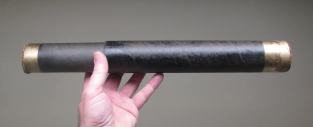
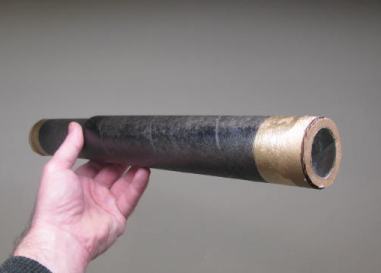
This article will show you the complete process for making a small refractor telescope. I also have a video that goes along with this tutorial. The picture below shows the telescope that I make and that you can make too.
Make your own telescope
Making a telescope is an extraordinarily rewarding experience because it crosses several different realms of experience. The first reward for you is the fun of making something. And the second reward is the sheer pleasure of using what you made to explore the universe. And you also get the added benefits of saving some money and learning about telescopes and building things.


The Simplest telescope you can make
There are a lot of different types you can make and the absolute simplest one you can make is composed of just two lenses. One large lens called an objective and a second smaller lens called an eyepiece. You hold one lens near your eye and another lens at arms length. You adjust the difference between the two by moving your arm in toward you. A point will be reached where everything comes into focus. It is as simple as that. You have a telescope. Now you can make it much better by creating a tube around it. Get two cardboard tubes with one that can slide in and out of the other. You mount one lens on the end of one tube and the other lens on the end of the other tube. Insert one tube into the other and then slide them in and out to find the focus.
You can get very inexpensive lenses from a variety of surplus and online stores and they generally will only cost a couple of dollars each. I recommend you get for your primary lens a convex lens at least 50 millimeters in diameter and a focal length of between 200 and 300 millimeters. For the secondary lens I recommend you get a convex lens that is between 10 and 25 millimeters wide with a focal length of less than 75 millimeters.
There are several things you can do to make this telescope even better. First off you could make a tube out of something more durable than cardboard tubes. Secondly, this type of telescope will invert images so everything appears upside down which is ok for viewing the sky but is very awkward for viewing things on the earth. You can solve this by using a concave lens for the eyepiece rather than a convex lens.
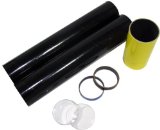
Note that amazon.com does have a nice little kit. I haven't tried it but it looks pretty good and includes the lenses
Make your Own Telescope complete kit with lenses
You can purchase the lenses individually from online surplus stores and there are several kits readily available that give you all the necessary materials to make this kind of telescope. They also come in bulk units for classroom and group use. A kit like this typically gives you all the materials needed to make ten or more telescopes.


Let's Make this Telescope

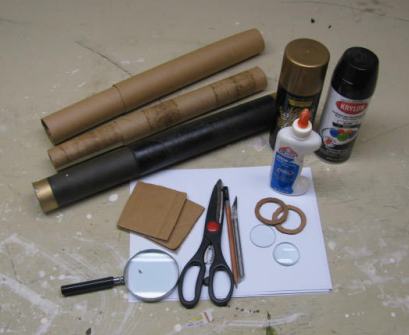
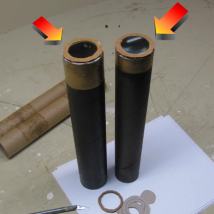
In this part of the telescope making tutorial I show you the nuts and bolts of how to make and assemble the telescope. I also have a video that shows you this and how to find the focal length of a lens. The picture below shows the parts needed to make this telescope.
parts and tools used to make this telescope

Parts and tools

  • Two cardboard tubes around 12" each; one should slide into the other
  • Two lenses of differing focal length
  • Two small pieces of corrugated cardboard
  • Scissors, pencil, razor knife, paint and glue
In part two you figured out the focal lengths of your lenses and you cut your tubes to appropriate lengths now all you really have to do is cleanly attach the lenses to the tubes. This can be a bit tricky and I went through a whole bunch of trials before I found a way that was easy and worked well. Here is what you do:
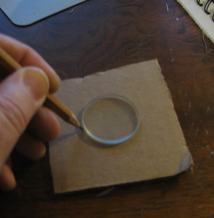
Trace the lens line
Put a lens down on the square of corrugated cardboard and draw a line around it. Do this whole process for both lenses. (make two of these)


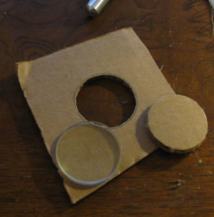
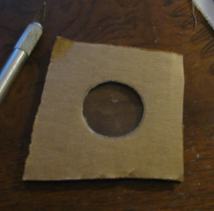
Cut teh lens hole out
Using an X-acto or razor knife cut the circle out. You can use scissors but it is rather difficult because you will tend to bend and distort the cardboard. Try to cut the circle so the hole is just a tiny bit smaller than the lens. Maybe about 1/32 of an inch
.


pop the lens in
Pop your lens right into the cardboard. Because of the thickness of the cardboard you should be able to squeeze the lens right in there and it will hold tight. If you have trouble or it doesn't hold tight then just use a little bit of glue and let it dry
.


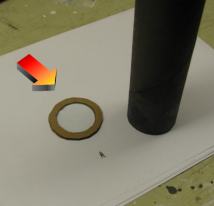
Trim the cardboard ring
Now, with a pair of scissors trim the cardboard ring so it is the same diameter as the tube. Remember that you have two tubes and each one is a different size because one slides into the other. Trim the ring with the long focus lens so it is the same size as your thicker outer tube. And trim the ring with the short focus lens so it is the same size as your thinner inner tube.


Glue rings onto tubes
Now glue each ring onto its respective tube.


Your telescope is complete
Slide the thinner tube into the thicker tube and your telescope is complete. Have fun!


Understanding the Optics of the telescope and lenses

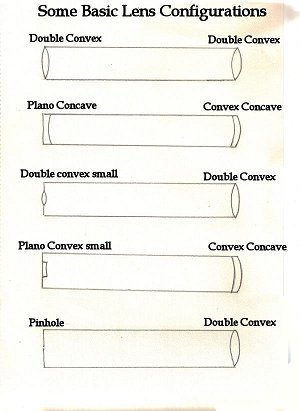
In this part of the tutorial on telescope making I will give you some specific advice on how to make a simple telescope with small lenses. There are several different configurations that you can use and I will explain them to you. This way you have the flexibility to scrounge up or purchase various parts.
In the following drawing there are five different telescope configurations you can make. This way you can make use of a variety of lenses and a variety of lens sizes. If you only have one lens you can also make a successful and useful telescope by using a pinhole.


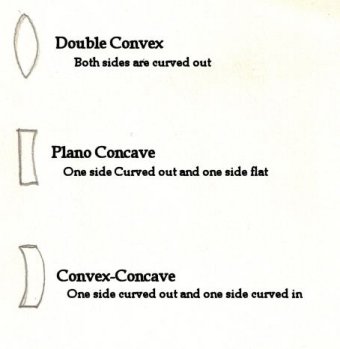
And here is a closer look at the types of lenses:
If you already have lenses check to see what type they are so you can use the appropriate set. If you don't yet have lenses I recommend you get a double convex and a plano convex. This will give you the best performing set and this is the same lens set that Galileo used to make his telescope.
Now lets talk a little bit more about the lenses and specifically about the focal length.
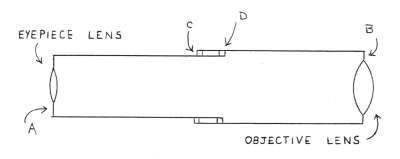
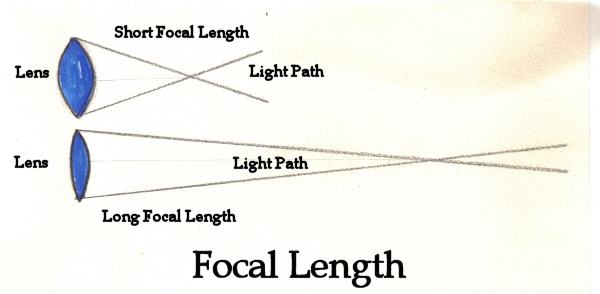
The focal length of the lens is important. This is the distance it takes the lens to bend light down to a point. For a home made telescope you need two lenses; one with a long focal length (this is the main lens furthest away from you and called the Objective). and a second lens with a short focal length (This is the eyepiece lens closest to your eye).
You have a lot of wiggle room when it comes to selecting lenses of various focal lengths because you are making a sliding tube telescope that will adjust to the focal length.
Typical focal length: If you are purchasing lenses here are the focal lengths I recommend: For the objective or main lens you should get something with a focal length of anywhere between 200 and 300 mm. You can go as high as 1000 mm if that is all you have. For the eyepiece lens you should pick something with a focal length less than 75 mm. 25 to 75mm would be good.
One thing to notice about the lenses in the illustration above is that the lens with the sharper and more pronounced curve has the shorter focal length. So, if you are looking at lenses you can get a sense for how long the focal length is by looking at the curve.

Lens Diameter - You have a lot of leeway when it comes to selecting lens diameter too. You can select two lenses that have the same diameter or you can choose One lens of a certain diameter for the objective and another lens that is about half that diameter for the eyepiece lens. When it comes to selecting lenses it is generally better to get the biggest lenses you can get. This means the telescope will gather more light and give you better viewing.
Recommendation: If you are looking for a recommended lens set here is a pretty good set:
  • Primary Objective lens: Convex-Concave 25mm diameter with a 300mm focal length
  • Eyepiece lens: Plano concave 25mm diameter with a 50mm focal length
Magnification of Your Telescope
The magnification of your telescope will depend on the focal lengths of the lenses you choose. There is an easy formula you can follow: The maginfication = the focal length of objective divided by the focal length of the eyepiece lens. In the project I make here the objective has a focal length of 30cm and the eyepiece is 5 so 30 divided by 5 = 6. The magnification of my little telescope is 6x.


Video Tutorial on how to make this telescope (This video also contains advice on how to find the focal length of a lens) 

Παρασκευή 30 Μαρτίου 2012

Sony Ericsson XPERIA X8 Apps / X10


Sony Ericsson XPERIA X8 Apps

Fruit Ninja HD Full
http://alldownloand.do.am/-.jpg
    Details:
Uploaded
20 Jan, 10:27PM
Popularity
> 100,000 downloads, 13 favourites
Type
apk
Size
9.40 MB
_____________________________________
Downloand Fruit Ninja HD Full
______________________________________
-------------------------------------------------------------------------------------

Talking Tom Cat 2


http://alldownloand.do.am/2.jpeg http://alldownloand.do.am/4.jpeg http://alldownloand.do.am/3.jpeg
   
Details :
Uploaded
14 Jan, 6:42PM
Popularity
> 100,000 downloads, 10 favourites
Type
apk
Size
7.34 MB
______________________________________
Downloand Talking Tom Cat 2
______________________________________

------------------------------------------------------------

Roll a Joint

http://alldownloand.do.am/5.jpeg http://alldownloand.do.am/6.jpeg

Details:
ploaded
27 Jan, 11:46AM
Popularity
> 30,000 downloads, 1 favourite
Type
apk
Size
2.30 MB

_______________________________________
Download Roll a Joint
_______________________________________

For Sony Ericsson XPERIA X8 Apps


Talking Dog


    Details:
Uploaded
17 Mar, 8:29AM
Popularity
> 5,000 downloads, 1 favourite
Type
apk
Size
5.68 MB


Download Talking Dog

all Linke Games For X10 : basketball_mooffoq6.apk - 3.1 Mb
Sony Ericsson XPERIA X10 Apps
https://blogger.googleusercontent.com/img/b/R29vZ2xl/AVvXsEhcBklMTr8mYcdU8qICLRW19LfDfRyVk1Yo9jtBqf1CPXiGOq6OMMN1-yF2tlW4eGzLQJUBt-GDfgfaNaF_o9s7x0VHBZ52rvl1h1yfpohOb-n0Lw8S6KbbTVij0UVX5Vv1UBKo9MWKPdw2/s1600/cooltext665077360.gif
Pes 2012
http://alldownloand.do.am/7.jpg
Details Uploaded 09 Nov, 2011, 2:23PM Popularity > 300,000 downloads, 46 favourites Type apk Size 5.32 MB Folder Games Version 1.00
Soak up the atmosphere of unprecedented football with PES 2012. Build your dream team by buying the most famous players. Would you like Ronaldo? Save up money and take it! Challenge a friend and play against him! In the new part of the improved behavior of players, the animation that makes the game more interesting. Play on a sunny day, playing in the rain and snow! training mode More than 5 leagues to choose from, Champions League and Europa League and the strongest national teams. 3 types of controls, 24 goals to choose from. 240x320, 360x640, 480x640, Other
-------------------------- Downloand --------------------------
Downloand Pes 2012
https://blogger.googleusercontent.com/img/b/R29vZ2xl/AVvXsEhcBklMTr8mYcdU8qICLRW19LfDfRyVk1Yo9jtBqf1CPXiGOq6OMMN1-yF2tlW4eGzLQJUBt-GDfgfaNaF_o9s7x0VHBZ52rvl1h1yfpohOb-n0Lw8S6KbbTVij0UVX5Vv1UBKo9MWKPdw2/s1600/cooltext665077360.gif
Basketball shots
http://alldownloand.do.am/9.jpg http://alldownloand.do.am/8.jpeg


Uploaded 20 Mar, 6:08AM Popularity > 5,000 downloads, 2 favourites Type apk Size 3.06 MB Folder Games Version 1.00 Tags new game sports In this Android game you have one basket and 4 balls, which you can throw to basket in order to gain scores. There is a time limitation of 45 seconds, thus you need to be quick to collect as much points as you can...ADD IN FAVOURITE
-------------------------- download --------------------------
downloand Basketball shots
https://blogger.googleusercontent.com/img/b/R29vZ2xl/AVvXsEhcBklMTr8mYcdU8qICLRW19LfDfRyVk1Yo9jtBqf1CPXiGOq6OMMN1-yF2tlW4eGzLQJUBt-GDfgfaNaF_o9s7x0VHBZ52rvl1h1yfpohOb-n0Lw8S6KbbTVij0UVX5Vv1UBKo9MWKPdw2/s1600/cooltext665077360.gif
Face Fighter

--------------------- Download ---------------------
Download Face Fighter


VISIT --> CHAT :) http://greekchat.do.am/videochat.html | To Greek Chat eine online edw kai 1 eudomada :) kai sintoma konta sas me neous admin's Kantai egrafi sto forum kai ginetai i 1 admin tou chat :) DIAFIMISTE TIN ETERIA SAS EDW !!! epikinoniste me ton diaxiristi tou sait kai Ok :P skype sto forum u Contact Us By wwWgreekchat.Do.am


JAMBO FILE


 Red Counter Strike